
Find Out Who Owns a Neshoba County Property
The surest route runs from a known place to a county identifier, and then from that identifier to the legal instrument. Start with the Delta Computer Systems appraisal search. It accepts an address number and street, an owner name, a parcel number, or a PPIN. Copy the spelling exactly. The card's owner field answers the practical question. It shows who owns the property as the assessment roll carries it today, though the portal itself cautions that frequent uploads can lag behind activity at the courthouse.
- Enter the street number and street name in the Neshoba appraisal search. If that fails, remove a road suffix or use the street-only result list.
- Open the matching record and save its PPIN, parcel number, owner name, mailing address, legal description, and newest book/page reference.
- Ask the Neshoba County Chancery Clerk to locate the newest instrument by book/page and confirm the named grantee and legal description.
- If the card names a company, compare its exact legal name with the Mississippi Secretary of State business search. Treat the registered agent as an entity contact, not automatically as the landowner.
This sequence guards against a common false match. Two people can share a name. Two roads can sound nearly alike, and a Philadelphia or Union mailing address does not settle jurisdiction by itself. The parcel number, the PPIN, and the legal description keep the property search tied to the exact piece of land.
Use the Neshoba Parcel Card as a Vocabulary List
A live Neshoba County parcel card offers more than an owner label. It can list separate mailing and property addresses, the parcel number and PPIN, Section/Township/Range, lot dimensions, use class, improvement details, a subdivision line, and transfer rows. Those fields teach you the county system's own vocabulary. Preserve the abbreviations exactly. S/D, PB, PG, book prefixes, corporate suffixes, and parcel punctuation all matter here. Silently "correcting" them can break a later deed records request.
The card for 244 Lewis Avenue shows the method at work. One sample is not a countywide promise. Still, its legal description and transfer references give concrete leads to carry to the clerk. The card also proves a useful point. The situs address, the tax-mail destination, and the deed vesting can serve three different administrative purposes.
The public 244 Lewis parcel-card source sits on the live appraisal system and displays these same fields.
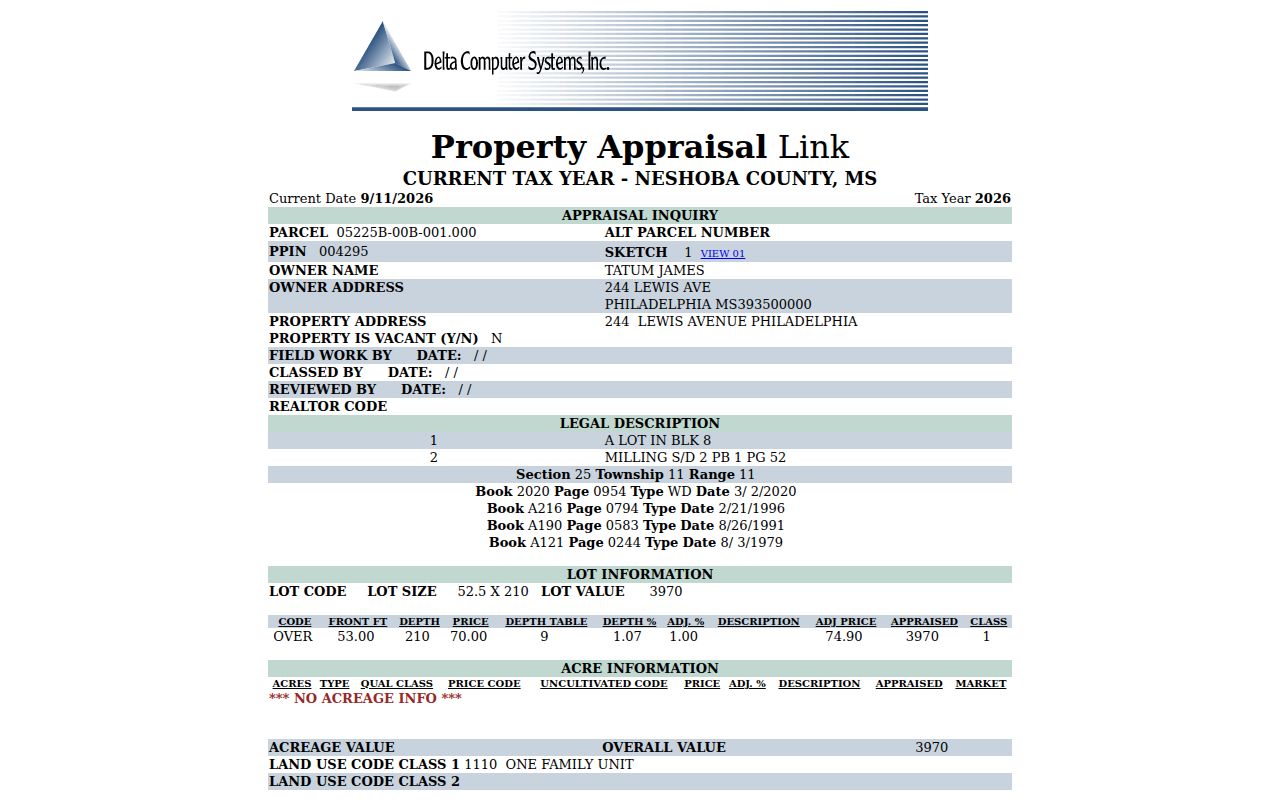
Read the parcel card as a field guide rather than a status report. It maps the county's terms without promising anything about the sample parcel's present condition.
Match Each Neshoba Owner Source to Its Job
No single screen answers every version of "who owns this property." The assessment roll is the fast first stop. The deed establishes the recorded conveyance, the plat fixes the lot context, and an entity record shows who can accept process for a company. Match the source to the question.
| Public record | Useful owner clue | How to reach it |
|---|---|---|
| Delta appraisal card | Owner as carried on the roll, mailing address, parcel, PPIN, and transfer leads | Public web search by address, name, parcel, or PPIN |
| Chancery land record | Grantee, vesting language, legal description, execution, and recording details | Public inspection at 401 E. Beacon Street, Suite 107, weekdays 8 a.m. to 5 p.m. |
| County ownership map or recorded plat | Which mapped or platted parcel corresponds to the address | County maps page and Chancery Clerk plat books |
| Mississippi business filing | Exact entity name, status, and registered-agent information | Secretary of State Standard Search by organization or individual |
The county website's "Search Land Records" wrapper points to Delta property and tax material. That is not an open Chancery deed index. The dependable deed route remains public inspection at the courthouse or a focused request to the clerk. The MEDIR eViewer landing page requires a login. It lists no Neshoba records cutoff.
Trace the Assessor Name to the Latest Neshoba Deed
The strongest answer comes when you open the newest instrument itself. Copying a book and page line is not enough. Bring the Chancery Clerk the PPIN or parcel number, the exact card name, and the newest book/page/type/date. Add the legal description. Ask for the index entry first if a reference is uncertain. Then request the specific deed or court document. The office states that deeds, mortgages, construction and condominium liens, and federal tax liens are open for inspection. Lis pendens and related land records are open too.
Read the grantee clause next. Study the vesting language, the legal description, the signatures, and the recording stamp. Note any referenced plat as well. A deed of trust names borrowers and a lender. It is not the ownership deed. A lien, a tax-sale notice, or a lis pendens works as a follow-up signal. It is not proof that title changed. For instrument mechanics and releases, continue to Neshoba County deed records.
- Owner of record
- The name carried by the governmental record being viewed, with its own effective or update date.
- Grantee
- The party receiving the interest described by a deed.
- Vesting
- The wording that states how title is held, including multiple-owner or fiduciary capacity.
- Situs and mailing address
- The property location and the destination for tax correspondence; they need not match.
Identify an LLC, Trust, or Estate Behind the Name
An LLC on a card needs one more step. Search the Mississippi Secretary of State business portal with the exact organization spelling, whether corporation or LLC. Compare the entity name and status against the deed and any permit or UCC record. A registered agent accepts service for the business. That role alone does not make the agent the beneficial owner of the real estate.
Trusts and estates take different follow-through. A deed may name a trustee in a representative capacity, while the beneficial parties never appear on the tax card. An estate name, multiple heirs, an executor, an administrator, or an unusual gap can point toward Neshoba Chancery Court, which handles estates and property disputes. Search the decedent's full legal name and spelling variants. Then match any order, fiduciary deed, heirs' deed, or partition to the same legal description. The goal is to explain the public chain of title. Private relationships stay private.
Let Neshoba Geography Test the Owner Match
Geography has a way of exposing a confident mistake. Union sits in both Neshoba and Newton counties. So a 39365 mailing address may point to the wrong county-side parcel entirely. The land's side of the line decides what you need. Assessor, Chancery Clerk, and tax collector records all depend on which county holds the parcel. Philadelphia's 39350 ZIP reaches past the city limits too. A postal city, a ward, and a tax district each answer a different question. A parcel boundary answers yet another one.
For rural tracts, the county's road and house-numbering map offers real help. It ties directional number ranges to township and range context. Use it to decode an E911 address or older road wording. Then run the appraisal search again. Treat it as orientation, not a deed description or boundary survey. Neshoba County property records for the two cities get deeper coverage elsewhere. See the Philadelphia property records and Union real estate records pages.
Turn an Owner Name into Neshoba House History
Once title is confirmed, the Neshoba County Public Library can fill in the human side of the story. Its genealogy holdings include books, periodicals, digitized yearbooks, census material, and deed and will indexes. The Neshoba Democrat microfilm runs from 1902 through 1977. Search a verified former owner, road, subdivision, or business name. That can surface occupancy details, address changes, obituaries, and local events.
Keep the evidence grades clear. A yearbook photo or newspaper item adds color. It proves nothing about title. The reliable handoff runs from library lead to clerk instrument. Then it goes to an assessor snapshot of the parcel. That discipline lets a house history grow richer. But no anecdote should harden into a title claim.
Know What a Neshoba Owner Lookup Does Not Prove
An owner name on a parcel record has firm limits. It does not list every occupant. It does not prove where a person lives now. Nor does it establish a complete title chain or guarantee that no newer deed sits waiting on a portal update. Blank fields show only that the field displayed blank. A permit applicant, a deed-of-trust borrower, a registered agent, and the tax-mail recipient can all differ from the vested owner of record. Record the source URL and access date with every conclusion you draw.
When the online record fails you, go to the source. Contact the Neshoba County Chancery Clerk at 401 E. Beacon Street, Suite 107, Philadelphia, or call 601-656-3581. Mississippi's Public Records Act allows inspection and copying, subject to exemptions and reasonable procedures. Ask narrowly for a specific index entry or document. Request a cost estimate before placing a large copy order.
Lawful use. Use a Neshoba County owner lookup for legitimate property research, purchase diligence, estate work, boundary questions, or house history. Do not use a public name or mailing address to stalk, harass, intimidate, or harm anyone, and do not attempt to defeat Mississippi's Address Confidentiality Program.